
Date: January 27, 2026
Category: Music & Culture / African Legends
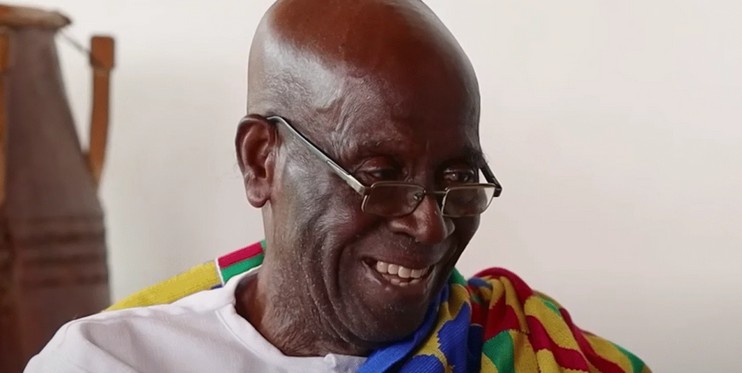
In an era dominated by synthesized beats and digital production, there remains a sturdy, acoustic pillar of Ghanaian heritage who has weathered the changing tides of nearly a century. The image of Agya Koo Nimo, draped in the rich colors of Kente and smiling beside the younger generation, is more than just a birthday portrait. It is a snapshot of history itself.
As we see him celebrated in his nonagenarian years (captioned here at his milestone 95th), we are reminded that Daniel Amponsah, known to the world as Agya Koo Nimo, is not merely a musician. He is a “living library” of Akan culture, a scientist, a storyteller, and the undisputed King of Palm Wine Music.
The Scientist with a Guitar
Born Daniel Amponsah in the village of Foase in the Ashanti Region, his life has been a fascinating duality of rigid science and fluid art. While official records often cite his birth in October 1934, his celebration of 95 suggests a deeper oral history placing his birth closer to 1931.
Unlike many of his peers who pursued music as a sole trade, Koo Nimo was a man of the laboratory. He worked for years as a technician in the Chemistry Department at the Kwame Nkrumah University of Science and Technology (KNUST). This discipline is often reflected in his music. It is precise, calculated, yet deeply experimental. He did not just play notes; he studied the chemistry of sound, blending the structured elegance of classical guitar with the soulful, ragged rhythms of traditional Akan music.
The Architect of “Palm Wine” Music
Koo Nimo’s greatest contribution to African music is his preservation and elevation of Palm Wine Music (or Highlife in its acoustic roots).
While Highlife evolved into electric dance bands in the cities, Koo Nimo stayed true to the “Seprewa” roots, the traditional Akan harp-lute. He transferred the complex melodies of the Seprewa onto the Western acoustic guitar, using a unique two-finger picking style that created a polyrhythmic sound impossible to replicate with a plectrum.
His ensemble, Adadam Agofomma (The Roots Ensemble), was formed to ensure that as Ghana modernized, its musical soul did not vanish. Through songs like “Ohia Ye Ya” (Poverty is Painful) and “Aburokyire Abrabo” (Life Overseas), he served as a social commentator. He wove Twi proverbs and Ananse stories into melodies that educated the youth and entertained the elders.
Key Contributions to Ghana and Africa
Agya Koo Nimo’s influence extends far beyond the fretboard of his guitar:
- Institutional Leadership: He served as the first President of the Musicians Union of Ghana (MUSIGA) in 1979. His leadership was crucial in organizing artists and advocating for copyright laws in a young nation.
- Cultural Ambassadorship: He has taken the intimate sounds of the Ashanti village to global stages, including the Lincoln Center in New York. He was the first Ghanaian artist to have his work released on a Compact Disc (CD) internationally, bridging the gap between local folk and the World Music market.
- Academic Preservation: Recognizing that oral traditions die with the holder, he has spent decades teaching and lecturing, including time at the University of Washington. This work ensured that the technical breakdown of African rhythms is documented for future ethnomusicologists.
A Legacy Etched in Gold
His chest, often draped in traditional cloth as seen in the photo, symbolically bears the weight of a nation’s gratitude. He has been decorated with the Grand Medal (GM) by the State of Ghana and received the prestigious Asahi Shimbun Nikkei Award in Japan for his contribution to world culture.
Conclusion: The “Odomankoma” Kyrema
In Akan tradition, the drummer who knows the history of the creation is called the Odomankoma Kyrema. Agya Koo Nimo is the guitar equivalent. As he sits in his wheelchair, smiling with the serenity of a man who has fulfilled his destiny, he reminds us of the power of staying true to one’s roots.
Happy Birthday to the legend, Agya Koo Nimo. His music does not just ask us to dance. It asks us to listen, to think, and to remember who we are.