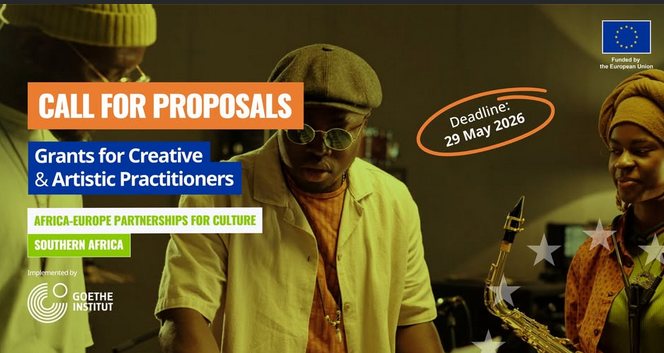
Whether you are a painter in Accra or a filmmaker in Lagos, the landscape of creative funding is shifting toward massive, cross-continental partnerships. The recent “Call for Proposals” from the Goethe-Institut Johannesburg is not just a flyer; it is part of a €70 million Africa-Europe Partnerships for Culture (AEPC) initiative funded by the European Union.
This blog breaks down how you can tap into these funds, specifically for those of us in West Africa.
🎨 The 2026 Opportunity: Is It Real?
Yes. The image refers to the “Narrative Clusters” and “Connect & Create” components of the AEPC. While the specific image mentions a deadline of May 29, 2026, for Southern Africa, this is part of a broader umbrella that covers all of Sub-Saharan Africa.
What’s on the Table?
- Narrative Cluster Grants: Up to €55,000 for organizations to lead interdisciplinary artist groups.
- Mobility Grants: Up to €4,000 for individual travel, research, and residencies.
- Co-Production Funds: €15,000 to €30,000 for collaborative works in music, theatre, and visual arts.
🌍 Opportunity for West Africa (Ghana & Nigeria)
While the flyer focuses on Southern Africa, the “Creativity in Clusters – Western Africa” arm of the Goethe-Institut is the direct counterpart for Ghana and Nigeria.
When do they open?
- Current Cycle: Large calls for West Africa typically launch in the last quarter of the year (October/November) for implementation the following year.
- Specific Residency: For example, the Arthouse Games Residency in Accra, Ghana, recently closed its call in March 2026 for a residency in April.
- Visual Arts: General Sub-Saharan calls often have “cut-off” dates in January and April.
Where to check?
If you are in West Africa, don’t wait for a flyer. Monitor the Goethe-Institut Ghana and Goethe-Institut Nigeria portals directly.
🏆 Past Winners & Success Stories
What does a winning project look like? Past grantees have focused on decolonization, digital innovation, and heritage.
- GamesConnect AFRICA (Ghana): Supported developers at Leti Arts to merge traditional African storytelling with modern gaming.
- Music In Africa (Continental): Supported the ACCES showcase, which has helped artists from Nigeria and Ghana perform on global stages.
- Visual Arts Collaborations: Past winners have created VR experiences that reconstruct historical West African sites or mobile exhibitions that travel between Lagos and Berlin.
🛠 Step-by-Step: How to Secure the Funds
1. Register on the “GAP” Portal
All applications go through the Goethe-Application Portal (GAP). Create your profile early; don’t wait for a deadline.
2. Find a “Tandem” Partner
Most of these grants require a Creative Tandem. This means you (in Ghana/Nigeria) should ideally partner with a creative in another African country or a European partner.
3. Draft a “Contemporary” Proposal
The Goethe-Institut prioritizes projects that:
- Use interdisciplinary approaches (e.g., Music + VR).
- Address heritage in a modern way.
- Support women, non-binary persons, and people with disabilities.
4. Build a Transparent Budget
You will need to use their specific Excel templates. Ensure your costs cover not just your “art,” but also outreach (how will the public see it?) and sustainability.
💡 How to Prepare Now
- Update your Portfolio: Have high-resolution photos and at least one video of a “live” performance or a “work-in-progress” ready.
- Network Regionally: Start talking to creatives in neighboring countries. Many grants require collaboration across at least three countries.
- Check your Legal Status: If you are applying for the larger €55k grants, you usually need to be a registered non-profit or NGO with at least two years of records.
Professional Tip: The biggest mistake applicants make is starting their project before the grant is signed. These funds are rarely retroactive—plan your project for at least 6 months after the application deadline.
The door is open—make sure your story is ready to be told.