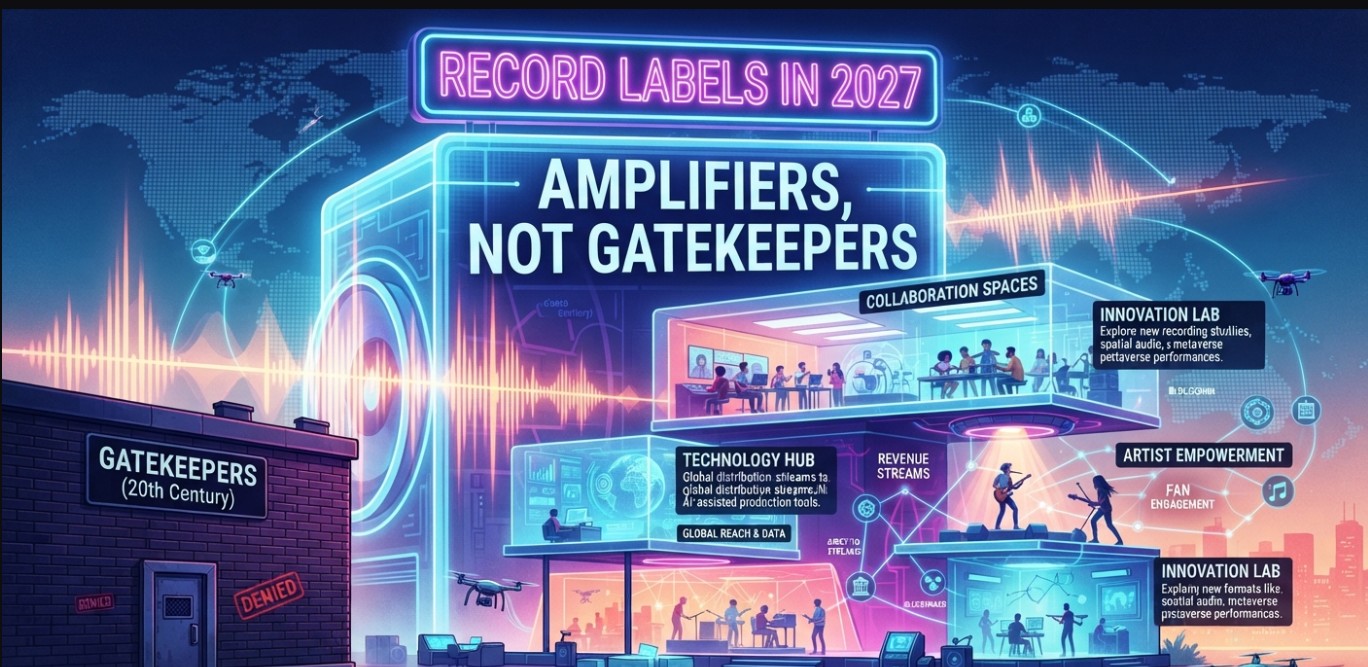
Record Labels in 2027: Amplifiers, Not Gatekeepers
The relevance of record labels has undergone a seismic shift over the last two decades. They are no longer the absolute gatekeepers they once were, but they are far from dead. Instead, their role has pivoted from development to amplification. For African musicians looking toward 2027, understanding this transformation is crucial.
🌍 Global vs. African Relevance of Record Labels
Globally: In the West, labels now function like venture capital firms. Distribution is democratized—anyone can upload to Spotify or Apple Music via DistroKid—but labels still monopolize scale. They control global playlist pitching, sync licensing (placing songs in films and ads), and multi-million-dollar marketing campaigns. An indie artist can go viral on TikTok, but only a label can transform that moment into a decade-long stadium career.
In Africa: Labels are uniquely relevant for two reasons: infrastructure and diaspora bridging.
- Infrastructure Gap: Africa has the talent and fans, but lacks robust royalty systems, distribution networks, and standardized legal frameworks. Major labels (Universal, Sony, Warner) are investing heavily to build this backend.
- Diaspora Bridge: To leap from African stardom to global superstardom, artists need boots on the ground in London, New York, and Los Angeles. Labels provide the networks for international collaborations (think Wizkid ft. Drake, Rema ft. Selena Gomez) and radio pushes that local indies cannot match.
🎛 How Labels Have Changed
Production:
- Then: Labels owned the studios; unsigned artists couldn’t make radio-ready music.
- Now: Production is democratized. Hits can be made on laptops in Lagos bedrooms. Labels now sign artists who already have proven hits, amplifying rather than creating.
Business Model (The 360 Deal): Streaming pays fractions of a cent. Labels now enforce 360 deals, taking cuts from touring, merch, and endorsements. For African artists—where live shows and brand partnerships are primary income streams—this can be devastating if poorly negotiated.
Copyright & Masters: Ownership is the battleground. Superstars like Taylor Swift and Burna Boy have made owning masters a crusade. Labels cling to master ownership for long-term passive income. While joint ventures and distribution deals exist for proven artists, new acts are often pressured into giving up their masters.
📌 Lessons for Upcoming African Musicians
- Build Before You Sign: Labels acquire assets, not dreams. Approach them with a buzzing single, loyal fans, and sold-out shows.
- Own Your Masters & Publishing: In Africa’s opaque royalty landscape, ownership is survival. Only trade masters if the advance is life-changing.
- Understand Split Sheets: Always document collaboration percentages. Ambiguity benefits labels, not artists.
- Treat Labels Like Loans: Advances are recoupable. Labels won’t pay royalties until costs are recovered.
- Local Indie vs. Major: Sometimes, a strong local indie offering fair splits is better than a major label shelving your career.
🔮 What to Expect Entering 2027
- AI & Copyright: AI-generated music will flood platforms. Authenticity, live performance, and cultural uniqueness will be the differentiators.
- Web3 & Direct-to-Fan: Blockchain and token-gated communities will empower artists to bypass label advances. Building email lists and WhatsApp communities now is key.
- Streaming Plateau, Live Renaissance: Streaming growth is slowing. Live shows, festivals, and VIP experiences will dominate revenue.
- Label Consolidation vs. Boutique Power: Expect majors to acquire more African catalogs, while boutique labels and artist-led collectives rise.
- Cross-Continental Infrastructure: With AfCFTA initiatives, monetization across the continent will become more feasible. Artists should seek partners with pan-African reach.
✨ Final Thought
By 2027, record labels will remain powerful amplifiers of scale and marketing. But they will be poor partners for artists without business acumen. The African artist of 2027 must be an entrepreneur first—mastering data, protecting copyright, building communities—and only using labels as accelerators, not engines.
Your art is the spark. Your business is the fuel. Labels are just the amplifier.